CI-003 · Venona · Arlington Hall, Virginia, 1943 - 1980
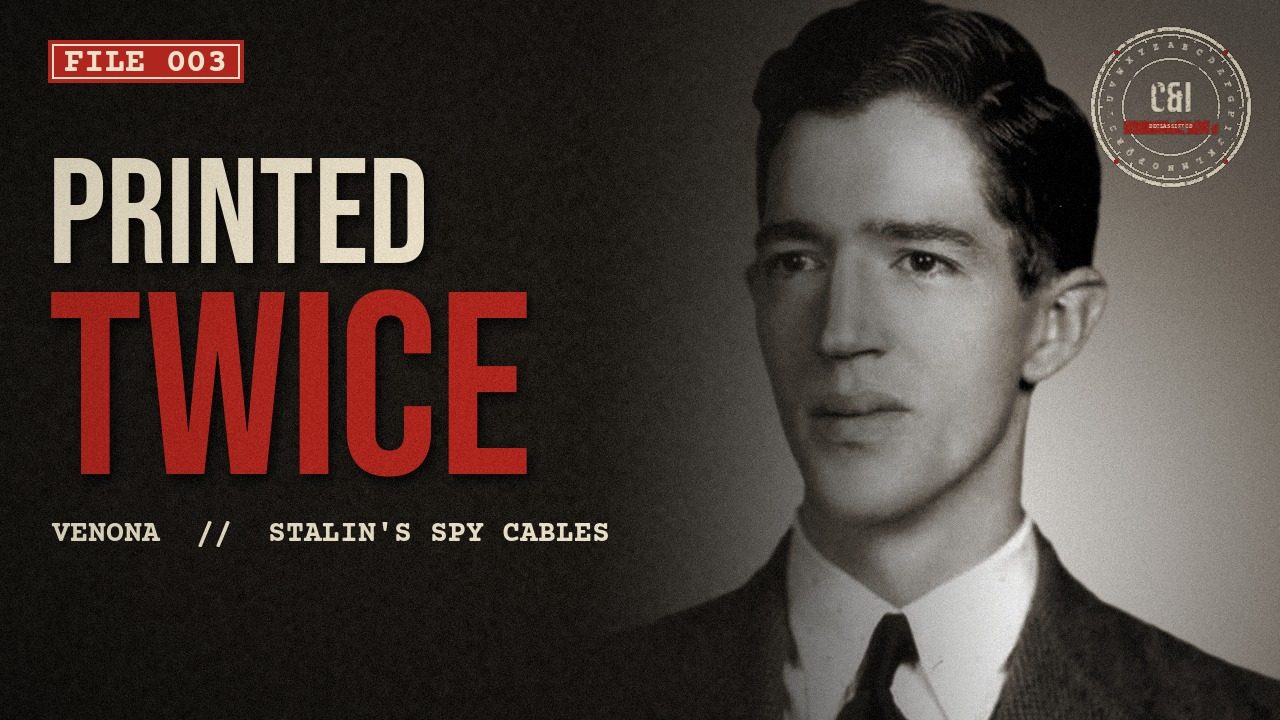
The Soviets' unbreakable cipher had one flaw: the same pages, printed twice.
From 1943 Army codebreakers at Arlington Hall worked on Soviet cables protected by one-time pads. A 1942 printing mistake let them read parts of KGB traffic and helped expose atomic spies. The program stayed secret until 1995.
Part of Cold War Secrets: The Declassified Files · YouTube playlist
 Opens Monday, November 30 at 8:00 AM ET
The file
In 1943 a small team of U.S. Army codebreakers at Arlington Hall began studying a pile of Soviet cables nobody had read. The Soviets protected them with one-time pads, a system that cannot be broken if each page is used once. But in early 1942 the Soviets had printed more than 35,000 pad pages twice. That flaw let Meredith Gardner and his colleagues read parts of KGB messages, and helped the FBI identify atomic spies including Klaus Fuchs and Julius Rosenberg. The program, Venona, was not officially revealed until 1995. This episode tells the story from NSA's own declassified histories and the decrypted cables.
- Primary source
- Benson & Warner (eds.), Venona: Soviet Espionage and the American Response 1939-1957 (NSA/CIA, 1996)
- Runtime
- 8:28
- Opens
- Monday, November 30 at 8:00 AM ET
Chapters
- 0:00 The list of names
- 0:56 Arlington Hall, 1943
- 1:48 How a one-time pad works
- 2:20 The flaw: 35,000 pages
- 2:57 Meredith Gardner
- 3:35 KAPITAN, ENORMOZ, LIBERAL
- 4:12 The FBI joins the hunt
- 4:48 The atomic spies
- 5:55 The leak
- 6:54 What Venona could not do
- 7:29 Declassified in 1995
- 7:54 Looking twice
Sources & credits
Sources
- Robert L. Benson & Michael Warner (eds.), Venona: Soviet Espionage and the American Response 1939-1957 (NSA/CIA, 1996)
- Robert L. Benson, The Venona Story (NSA Center for Cryptologic History, 2001; reprinted 2012, 2019)
- NSA Venona translations (released 1995-1997), as reproduced in Benson & Warner
- NARA, U.S. v. Julius & Ethel Rosenberg and Morton Sobell, trial exhibits (RG 118, Records of U.S. Attorneys)
- John Ehrman, 'The Mystery of ALES: Once Again, the Alger Hiss Case', Studies in Intelligence 51:4 (CIA, 2007) / Kai Bird & Svetlana Chervonnaya, 'The Mystery of Ales', The American Scholar (Summer 2007), on the disputed ALES identification
Maps
Original reconstructions from Natural Earth data (public domain) and © OpenStreetMap contributors (ODbL; modern road layout); cable routes are schematic.
Image credits
Public domain / CC0 (45 images): unknown photographers; U.S. Army; CIA; FDR Presidential Library; NSA; Esther Bubley; NARA; Harris & Ewing / Library of Congress; New York World-Telegram (Library of Congress); Ed Westcott / DoE Oak Ridge; The National Archives UK; U.S. Department of Justice; David Greenglass; Berlyn Brixner / Los Alamos National Laboratory; U.S. Army Signal Corps / NARA; Daderot (CC0)
Creative Commons (via Wikimedia Commons):
- VENONA decrypt allegedly re Alger Hiss.agr / ArnoldReinhold / CC BY-SA 4.0
- National Cryptologic Museum / Coolcaesar at en.wikipedia / CC BY-SA 3.0
- VENONA decrypt re isotope separation.agr / ArnoldReinhold / CC BY-SA 4.0
- Document pages: Robert L. Benson & Michael Warner (eds.), Venona: Soviet Espionage and the American Response 1939-1957 (NSA/CIA, 1996) / Public domain
- Document pages: Robert L. Benson, The Venona Story (NSA Center for Cryptologic History, reprinted 2019) / Public domain
License texts: creativecommons.org/licenses/by-sa/3.0/ | creativecommons.org/licenses/by-sa/4.0/
Music
- "Slow Sneak Up" by Godmode (YouTube Audio Library)
- "Lake Jupiter" by John Patitucci (YouTube Audio Library)
- "Spaghetti Eastern" by John Patitucci (YouTube Audio Library)
- "Apocalyptic Echoes" by Jimena Contreras (YouTube Audio Library)
- "Minor Lament for Solo Bass" by John Patitucci (YouTube Audio Library)
Narration uses a synthetic voice. Maps and graphics are original reconstructions, not historical documents.
#ColdWar #Venona #Espionage #NSA #Declassified
Narration uses a synthetic voice. Maps and graphics are original reconstructions, not historical documents. Spotted an error? We correct the record: see our corrections policy.